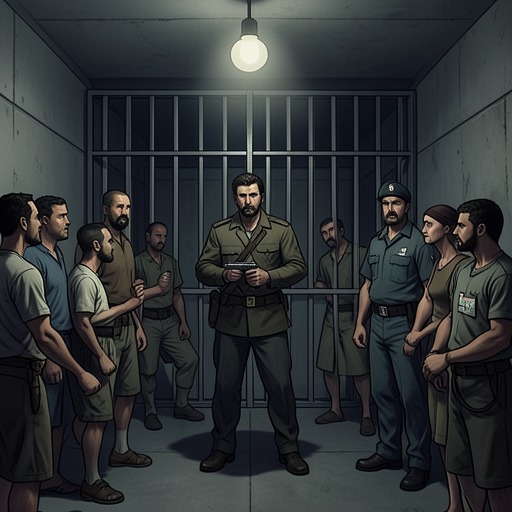
The Marionettes
Three SecondsThe Marionettes is a prison-library book whose binding conceals components of an improvised explosive device. Piet Hoffmann takes it apart while held in voluntary isolation, converting an ordinary object supplied by the prison into a hidden store of equipment for the crisis unfolding around him.
The book and its concealment
The book is one of two hardbound volumes Hoffmann brings to his bed in the isolation cell: Nineteenth Century Stockholm and The Marionettes. Both have plain, monochrome library boards, marked STORE in blue and ASPSS LIBRARY in red. He works on them while the corridor is quiet, turning his back to the locked cell door so that anyone looking through its hatch would see only an insomniac prisoner shifting position.
The sequence distinguishes the books’ contents. Hoffmann first tears apart Nineteenth Century Stockholm and finds a concealed cavity; he then dismantles The Marionettes in the same way. The second book yields the components associated with the explosive device, rather than the miniature firearm found among the first book’s concealed contents.
Components hidden inside
Inside The Marionettes, Hoffmann finds a detonator described as nail-sized and a receiver about the size of a penny. He opens the thick covers along their lower edges, cuts through the glued hinge with a sewing-machine screwdriver, and removes two lengths of pentyl fuse, each nine metres long, along with a thin plastic envelope holding twenty-four centilitres of nitroglycerine. The book’s value lies in the separation between its harmless public identity and the compact, dangerous materials hidden within its boards and binding.
Use during the prison crisis
Hoffmann later has the receiver in a front pocket in the prison workshop. After binding the prisoner and guard there, he places the receiver in his ear and listens; looking toward the church tower, he hears wind crossing a transmitter and knows the equipment works. The scene connects the object’s hidden contents to a wider arrangement involving a transmitter, while stopping short of establishing exactly what triggers the loud, repetitive sound that follows.
Narrative significance
The book changes function as Hoffmann’s circumstances change. It begins as an apparently routine library volume in a prison that controls access to space, time, and possessions; in isolation, he exposes its material interior and turns it into a resource the institution does not recognize. Its concealment depends on the ordinary appearance of the boards, the prison’s own library markings, and Hoffmann’s careful timing in a locked cell. The Marionettes therefore makes the prison’s objects part of the struggle within its controlled environment: a book issued for reading becomes a hidden component in Hoffmann’s effort to survive and act.